
If you've scheduled your first hearing test, you might be wondering what to expect. The American Academy of Audiology notes that understanding the process can help ease anxiety and ensure you get the most accurate results.[1]
Before Your Appointment
A little preparation can help make your appointment go smoothly:[2]
Gather your medical history: Note any medications, previous ear problems, and family history of hearing loss
List your concerns: Think about specific situations where you struggle to hear
Bring a loved one: They can provide insight into your hearing challenges
Avoid loud noise: Try to avoid loud environments 24 hours before your test
The Consultation
Your appointment begins with a case history conversation. Your audiologist will:
Review your medical and hearing history
Ask about your lifestyle, occupation, and communication needs
Discuss specific hearing challenges you've noticed
Answer any questions you have
Physical Examination (Otoscopy)
Using an otoscope, your audiologist will examine your ear canal and eardrum. This painless examination checks for earwax buildup, signs of infection or inflammation, eardrum condition, and any visible abnormalities requiring medical referral.
The Hearing Tests
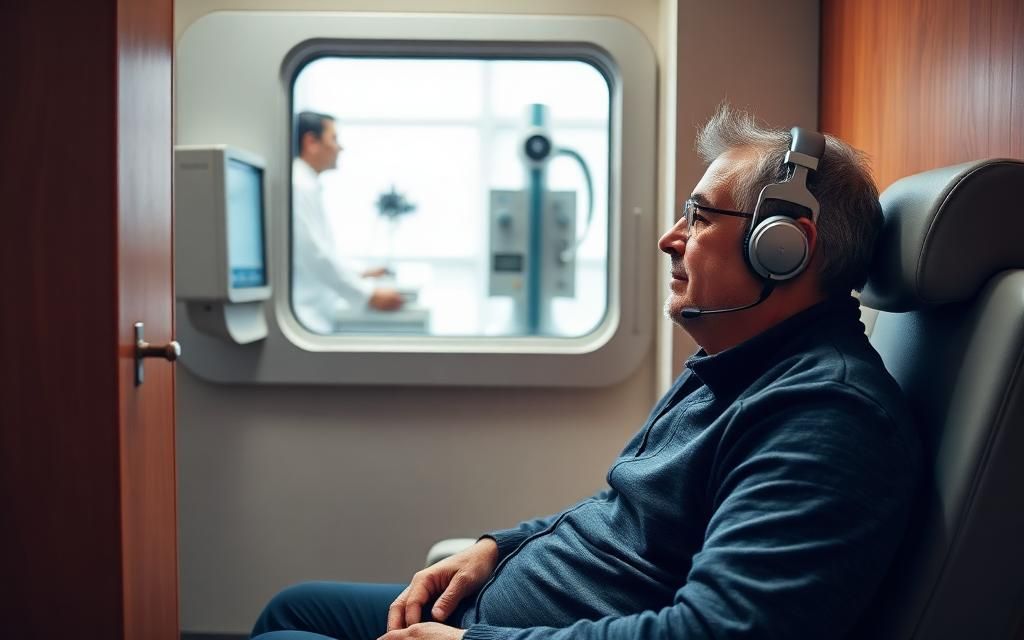
You'll sit in a sound-treated booth for the actual hearing tests:[3]
Pure-Tone Audiometry
You'll wear headphones and listen for tones at different pitches and volumes. When you hear a tone, you'll press a button or raise your hand.
Speech Audiometry
You'll listen to words at different volumes and repeat them back, which helps determine how well you understand speech.
Tympanometry
A small probe measures how your eardrum responds to changes in air pressure, evaluating middle ear function.
Understanding Your Results
After testing, your audiologist will review your results using an audiogram:[4]
The type of hearing loss (sensorineural, conductive, or mixed)
The degree of hearing loss (mild, moderate, severe, or profound)
Which frequencies are affected
How your results compare to age-normal hearing
Clear recommendations for next steps
References
American Academy of Audiology. (2024). What to Expect During a Hearing Evaluation.
American Speech-Language-Hearing Association. (2024). Adult Hearing Screening.
American Speech-Language-Hearing Association. (2024). Audiometry.
American Academy of Audiology. (2024). Audiogram Interpretation.
Frequently Asked Questions
Does a hearing test hurt?
No. A hearing evaluation is completely painless from start to finish. The otoscopy involves a light being shone into your ear canal. The tympanometry uses a gentle puff of air. The booth-based tests just require you to listen and respond. Nothing uncomfortable happens at any point.
How long does a hearing test take?
A comprehensive hearing evaluation typically takes about 60 minutes, including the consultation, testing, and results review. Some clinics offer shorter screening tests (15–20 minutes), but a full evaluation gives you a much more complete picture and is worth the extra time.
Do I need a referral to get a hearing test?
In most cases, no. You can schedule directly with an audiology clinic like United Hearing Centers without a physician referral. If your results suggest a medical cause for your hearing loss, your audiologist may refer you to an ENT for follow-up.
Will I get my results the same day?
Yes. Your audiologist will review your audiogram and all results with you immediately following the tests — no waiting for lab results or a follow-up appointment.
What should I bring to my hearing appointment?
Bring any relevant medical history, a list of current medications, and if possible, a family member or close friend. Their perspective on your hearing challenges is genuinely helpful to the audiologist, and having someone with you during the results conversation supports follow-through.
Does United Hearing Centers charge for the initial evaluation?
United Hearing Centers offers complimentary hearing evaluations. Contact us to confirm what's included and whether your insurance covers follow-up services.
United Hearing Centers provides comprehensive hearing evaluations, hearing aid fittings, and ongoing audiology care. Our audiologists are dedicated to helping adults hear better and live more fully.