

Key Takeaways
Approximately 40 million American adults have noise-induced hearing loss — and most of it was preventable
Sounds above 85 dB can permanently damage inner ear hair cells with prolonged exposure
The 60/60 rule (60% volume, 60 minutes max) significantly reduces headphone-related hearing risk
Quality hearing protection reduces exposure by 15–33 dB depending on the type
Cardiovascular health, smoking, and lifestyle choices all affect long-term hearing
Most people assume hearing loss is simply what happens with age. And while presbycusis — age-related hearing decline — is real, a significant portion of hearing loss is entirely preventable. The Centers for Disease Control and Prevention estimates that approximately 40 million American adults aged 20–69 have noise-induced hearing loss, much of it accumulated gradually over years of everyday noise exposure.[1]
The hearing you have today is largely a product of the choices you've made over decades. The hearing you have at 70 depends heavily on the choices you make now.
Here's what the evidence actually says about protecting it.
Understanding Noise-Induced Hearing Loss
Noise-induced hearing loss (NIHL) occurs when loud sounds damage or destroy the tiny hair cells in the cochlea — the spiral-shaped structure in your inner ear responsible for converting sound vibrations into signals the brain can understand. According to the NIDCD, these hair cells cannot regenerate once damaged.[2] The loss is cumulative and permanent.
The critical threshold, according to OSHA, is 85 decibels (dB) — the point at which prolonged exposure begins causing measurable damage.[3] To put that in context:
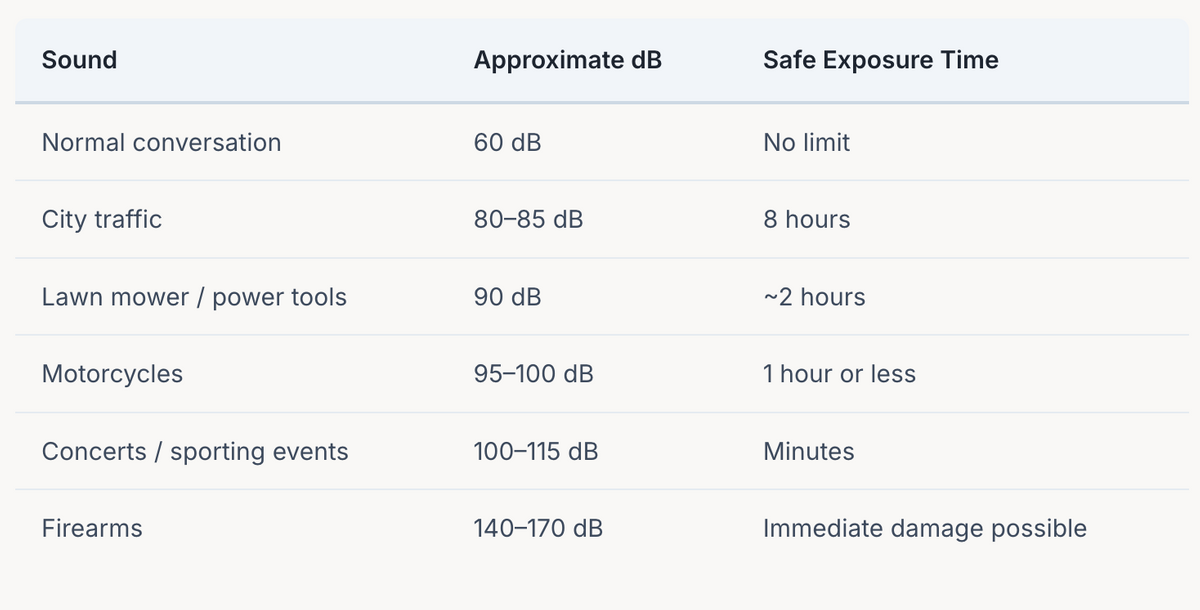
The key insight here is that damage isn't just about loudness — it's about loudness multiplied by time. Brief exposure to moderately loud noise is far less harmful than sustained exposure to moderate noise day after day, year after year.
1. Wear the Right Hearing Protection
Not all hearing protection is the same, and choosing the right type for the situation makes a real difference. The Noise Reduction Rating (NRR) on hearing protection tells you how many decibels it reduces exposure by. NIOSH recommends selecting protection rated appropriately for your specific noise environment.[4]
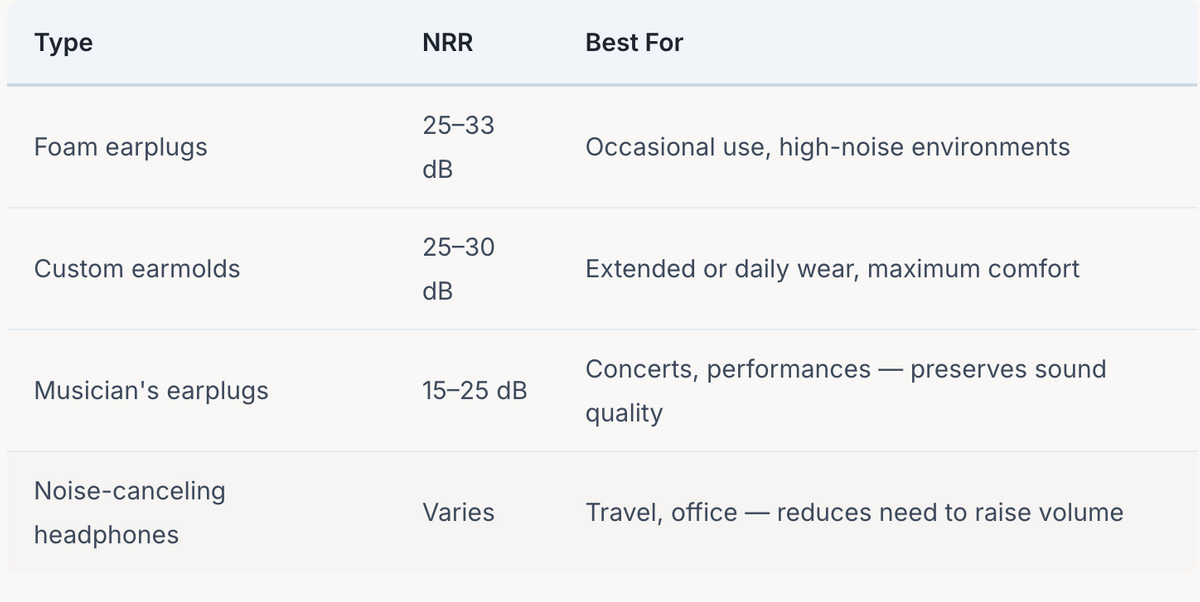
A few practical notes: foam earplugs are only effective when inserted correctly — they need to be rolled, inserted deeply, and allowed to expand fully. Many people wear them too loosely, cutting the effective NRR significantly. For anyone in noisy work environments daily, custom earmolds from an audiologist are worth the investment for both protection and long-term comfort.
2. Follow the 60/60 Rule for Headphones
Personal audio is one of the fastest-growing sources of noise-induced hearing loss, particularly among younger adults — but it affects all age groups. The World Health Organization estimates that over 1 billion people are at risk from unsafe listening practices.[5]
The 60/60 rule, endorsed by audiologists worldwide: listen at no more than 60% of maximum volume for no more than 60 minutes at a time, followed by a break.
A few other habits that protect your hearing during personal audio use:
Use over-ear headphones when possible. In-ear earbuds deliver sound more directly to the eardrum at closer proximity. Over-ear headphones at the same perceived volume are generally less damaging.
Use noise-canceling headphones in loud environments. The instinct to turn up volume to drown out background noise is one of the most common ways people accidentally damage their hearing. Noise-canceling headphones break that cycle.
Enable volume limits on your devices. Both iOS and Android allow you to set a maximum volume cap. It's a simple setting that takes 30 seconds to configure and removes the temptation to push past safe levels.
3. Give Your Ears Recovery Time
Ears are more resilient than most people realize — but they need time to recover after loud exposure. The World Health Organization recommends at least 16 hours of quiet following 15 minutes of exposure at 100 dB.[5]
That temporary muffled feeling or ringing after a loud concert is called a temporary threshold shift — a sign that your hair cells have been stressed. With adequate rest, hearing typically returns to baseline. The problem is when recovery time isn't provided, and temporary shifts accumulate into permanent ones over years.
After attending a loud event, a day of quiet activity is genuinely protective. If you're regularly experiencing ringing or muffled hearing the day after noise exposure, that's a signal worth taking seriously — and worth mentioning at your next hearing evaluation.
4. Protect Your Hearing at Work
Occupational noise exposure is one of the most significant — and most underappreciated — causes of hearing loss. Industries with the highest risk include construction, manufacturing, agriculture, military service, and live entertainment. If you work in any of these environments, OSHA requires your employer to provide hearing protection when noise levels exceed 85 dB over an 8-hour workday.[3]
Make the most of workplace protections:
Wear provided hearing protection every time — not just on the loudest days. Inconsistent use drastically reduces its effectiveness over a year. Take advantage of annual workplace hearing screenings; they exist for a reason and catch changes early. Report any perceived changes in your hearing to your supervisor or occupational health program — early detection leads to better outcomes. If you're self-employed or your employer isn't providing adequate protection, consult an audiologist about appropriate PPE for your specific environment.
5. Make Lifestyle Choices That Support Hearing Health
Hearing health doesn't exist in isolation — it's deeply connected to your cardiovascular and overall physical health. Research published in the American Journal of Medicine demonstrates a meaningful connection between cardiovascular health and hearing function: the inner ear is highly sensitive to blood flow, and conditions that restrict circulation affect it directly.[6]
Habits that support long-term hearing health:
Regular cardiovascular exercise promotes blood flow throughout the body, including to the delicate structures of the inner ear. Even moderate activity — 30 minutes of walking most days — makes a difference.
Not smoking. Research suggests smoking can roughly double the risk of hearing loss, likely through reduced blood flow and increased susceptibility to oxidative damage in the inner ear.
Managing blood pressure and cardiovascular disease. Hypertension and heart disease are consistently associated with higher rates of hearing impairment.
Limiting excessive alcohol consumption. Heavy alcohol use has been linked to both central auditory processing issues and inner ear damage over time.
6. Schedule Regular Hearing Evaluations
Prevention is most effective when paired with monitoring. Even with excellent hearing habits, annual or biannual hearing evaluations allow for early detection of any changes — and early detection means more options.
The Mayo Clinic recommends hearing tests every 10 years until age 50, then every 3 years after that. For anyone with occupational noise exposure, recreational noise exposure, or a family history of hearing loss, more frequent evaluations are appropriate.
At United Hearing Centers, we offer comprehensive hearing evaluations for adults at all stages — whether you're monitoring your hearing proactively or starting to notice changes. Our audiologists will give you a clear picture of where your hearing stands and what, if anything, you should do about it.
References
Centers for Disease Control and Prevention. (2024). Noise-Induced Hearing Loss. cdc.gov
National Institute on Deafness and Other Communication Disorders. (2024). Noise-Induced Hearing Loss. nidcd.nih.gov
Occupational Safety and Health Administration. (2024). Occupational Noise Exposure. osha.gov
National Institute for Occupational Safety and Health. (2024). Hearing Protector Selection. cdc.gov/niosh
World Health Organization. (2024). Make Listening Safe. who.int
Friedland, D.R., et al. (2009). Cardiovascular Disease and Hearing. American Journal of Medicine.
Frequently Asked Questions
What volume is safe for headphones?
The standard guideline is no more than 60% of maximum volume for no more than 60 minutes at a time. Most smartphones and streaming devices now include hearing health features that track your audio exposure and alert you when you've exceeded safe weekly limits — worth enabling if you use headphones regularly.
How loud is too loud? How can I tell?
A useful rule of thumb: if you have to raise your voice to be heard by someone an arm's length away, the environment is above 85 dB and potentially damaging with extended exposure. Free sound level meter apps on smartphones give a reasonably accurate reading and are useful for checking unfamiliar environments.
Do noise-canceling headphones protect your hearing?
Indirectly, yes. Noise-canceling headphones don't block damaging sounds the way earplugs do — they use active noise cancellation to reduce background noise, which means you don't have to turn up your music or audio to compensate. This keeps listening levels lower and reduces cumulative exposure over time.
Can you reverse noise-induced hearing loss?
No — once the hair cells in the inner ear are damaged, they don't regenerate. What you can do is prevent further damage and manage existing hearing loss effectively with hearing aids or other devices. This is why prevention and early detection are so critical.
Is one loud event enough to damage your hearing permanently?
Extremely loud, brief sounds — like a gunshot near the ear, or an explosion — can cause immediate, permanent damage. A single concert at typical volumes is more likely to cause temporary threshold shift (muffled hearing, ringing that resolves within a day), but repeated exposure without recovery time converts temporary damage into permanent loss over time.
How do I know if my workplace is too loud?
OSHA sets the action level at 85 dB over an 8-hour workday. If you regularly leave work with ringing ears or muffled hearing, your workplace noise exposure is almost certainly at or above this threshold. Your employer is legally required to provide hearing protection and annual hearing screenings in OSHA-regulated noise environments.
Does United Hearing Centers offer hearing protection fittings?
Yes. In addition to hearing evaluations, United Hearing Centers can fit custom earmolds for hearing protection — particularly valuable for musicians, industrial workers, hunters, and frequent concertgoers who need protection that's both effective and comfortable for extended wear.
United Hearing Centers provides comprehensive hearing evaluations, hearing aid fittings, and ongoing audiology care. Our audiologists are dedicated to helping adults hear better and live more fully.